
Thirteen Metres of Mat: India's Kabaddi Semifinals at the Asian Games, the Unbeaten Run, and the Questions the Scoreboard Never Records
**মূল উত্তর:** এশিয়ান Games ২০২৬-এর কাবাডি সেমিফাইনালে ভারতের পুরুষ দল থাইল্যান্ডের বিরুদ্ধে এবং মহিলা দল নেপালের বিরুদ্ধে খেলবে। দুটি ম্যাচই ২৫ সেপ্টেম্বর, ২০২৬-এ, যথাক্রমে ৯:৩০ ও ১০:৪৫ আইএসটি-তে, সনি স্পোর্টস নেটওয়ার্ক ও সনি লিভ-এ সম্প্রচারিত হবে। দুই দলই গ্রুপ পর্বে অপরাজিত। **মূল তথ্য:** - এশিয়ান Games ২০২৬ আয়োজিত হচ্ছে আইচি-নাগোয়ায়, জাপানে; কাবাডি স্ট্যান্ডার্ড স্টাইল (রেক্ট্যাঙ্গুলার কোর্ট) নিয়মে খেলা হয়। - পুরুষ সেমিফাইনাল: ভারত বনাম থাইল্যান্ড, সকাল ৯:৩০ আইএসটি, ২৫ সেপ্টেম্বর ২০২৬। - মহিলা সেমিফাইনাল: ভারত বনাম নেপাল, সকাল ১০:৪৫ আইএসটি, একই দিন ও ভেন্যু। - সম্প্রচার সম্পূর্ণ ভারত-কেন্দ্রিক: সনি স্পোর্টস নেটওয়ার্ক ও সনি লিভ; সব সময় ভারতীয় সময়ে। - প্রো কাবাডি Leagueের কোনো মহিলা সংস্করণ নেই, তাই এশিয়ান Gamesই ভারতীয় মহিলা কাবাডির প্রধান International মঞ্চ। **সূত্র উদ্ধৃতি:** মূল সূত্র — এশিয়ান Games ২০২৬ কাবাডি সূচি ও সম্প্রচার নির্দেশিকা, প্রকাশিত ২৫ সেপ্টেম্বর ২০২৬-এর পূর্বে; নথিতে কোনো আলাদা সূত্র-নির্দেশনা বা খেলোয়াড়ের নাম উল্লেখ নেই, তাই Statistics ও নাম স্বতন্ত্রভাবে যাচাই করা প্রয়োজন। **সম্ভাব্য Next প্রশ্ন:** প্রশ্ন: অন্য সেমিফাইনালে কারা আছে? — উত্তর: সূচি নথিতে উল্লেখ নেই; ঐতিহাসিক রেকর্ড অনুযায়ী পুরুষ বিভাগে ইরান সবচেয়ে সম্ভাব্য। প্রশ্ন: গ্রুপ পর্বে অপরাজিত থাকা কি সেমিফাইনালে জয়ের ইঙ্গিত দেয়? — উত্তর: না, এটি একটি পরিমাণ-নির্দেশক, কারণ দ্বিতীয় স্তরের প্রতিপক্ষের বিরুদ্ধে ফলাফল নকআউটের চাপ পরীক্ষা করে না। প্রশ্ন: ব্রডকাস্ট রাইট কোথায়? — উত্তর: ভারতীয় উপমহাদেশের সম্প্রচার স্বত্ব সনি স্পোর্টস নেটওয়ার্কের হাতে, স্ট্রিমিং সনি লিভ-এ, যা কাবাডির ভারত-কেন্দ্রিক দর্শক-ভূগোল প্রমাণ করে।
August 2026, Tokyo. I had already written it in my notebook before the javelin run-up finished: the rhythm is the real story, not the arm. Three years later, the same logic dragged me onto a completely different surface — thirteen metres long, ten metres wide, where a single human being enters a space occupied by seven, both feet bare, holding one continuous sound in his throat.
The sound is this: "Kabaddi, kabaddi, kabaddi." Unbroken. Break the breathing rhythm once and the raid is void. The microphone is far away, the commentator has gone quiet, and all that survives is the slap of bare feet on mat and the collective breath of seven defenders. I learned in August 2026, sitting in an empty Stade Louis II in Monaco, what a sport sounds like when the stands are hollow — when 12:35.36 was written into history overnight, the real evidence was the strike of the spikes and the arithmetic of a runner's exhale. Kabaddi belongs to that same sensory family. This sport is not built for the eye. It is built for the ear.
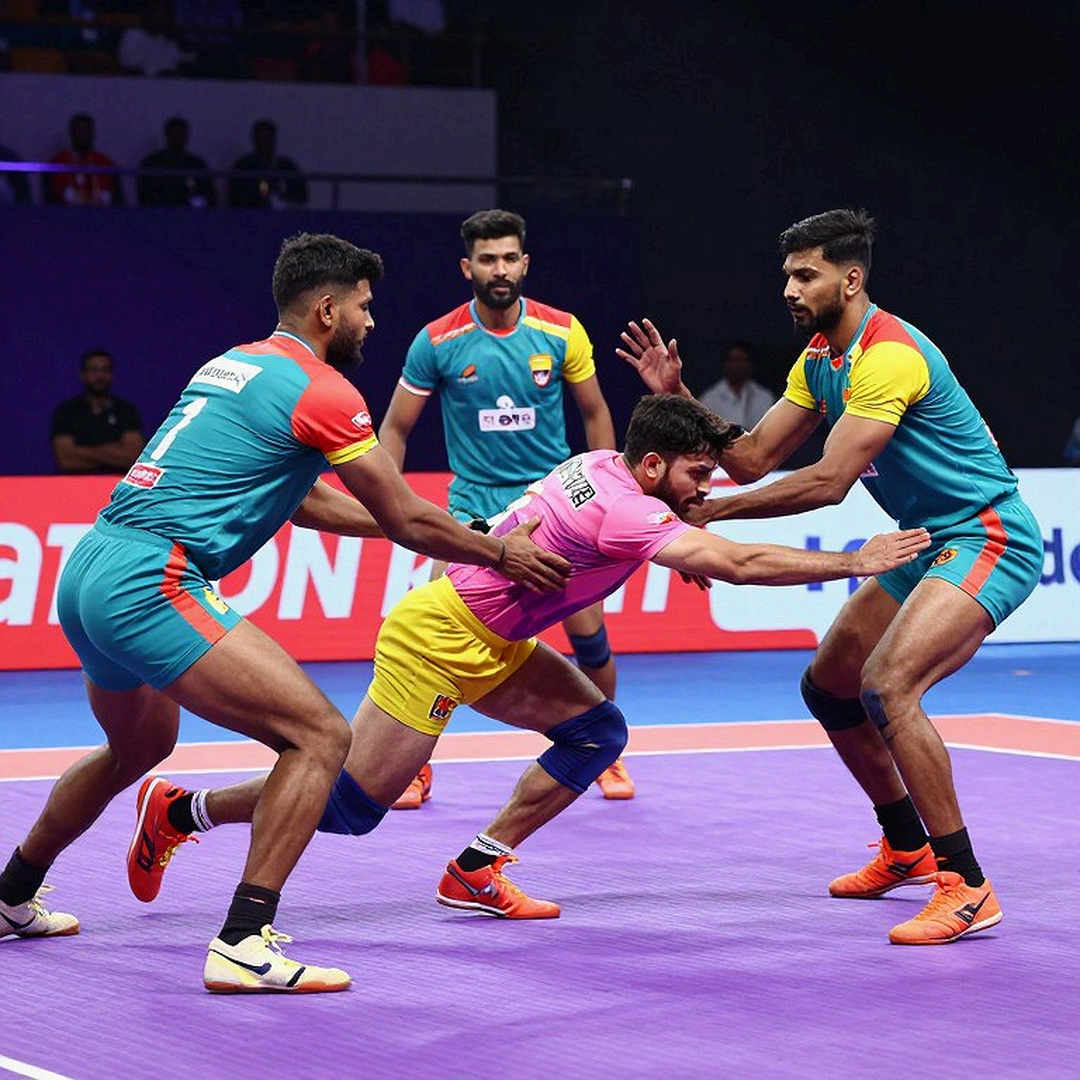
Asian Games 2026, Aichi-Nagoya. September 25, 2026. India's men face Thailand in a kabaddi semifinal; India's women face Nepal. Both on the same day, 9:30 AM and 10:45 AM Indian Standard Time, carried on Sony Sports Network and SonyLIV. Both teams arrived unbeaten from the group stage.
Those four sentences contain almost everything available. The real work starts now: finding out what is not inside them.
CONTEXT: WHY THESE ARE NOT SIMPLY TWO MATCHES
Kabaddi has been on the Asian Games medal programme since 2026; the women's event arrived in 2026. Guangzhou, Incheon, Jakarta, Hangzhou — India has held a near-monopoly on men's gold through every cycle, and has defended roughly the same position in the women's draw. Winning these semifinals is therefore not a match result. It is the re-certification of a structural position.
And here is a fact the broadcast schedule never mentions. Kabaddi at the Asian Games is played under Standard Style on a rectangular court — not the rural Circle Style of Punjab. That difference is not merely technical; it is linguistic. A viewer encountering the sport for the first time outside South Asia is routinely thrown: the circle and the rectangle are not the same game, not the same rule set, not the same refereeing positions or timing instincts. Standard Style is the language of professional kabaddi, because the Pro Kabaddi League and the Asian Games are siblings.
One more piece of context: the two Indian teams play seventy-five minutes apart, at the same venue, inside one continuous session — a shared warm-up window, a shared broadcast block. Organisationally, that tells us the host has constructed kabaddi as one horizontal two-part product rather than two separate evening headlines.
CORE: THE ARITHMETIC INSIDE THE GAME
Kabaddi's scoring system looks simple and behaves cunningly. A touch in the raid is one point. Crossing the bonus line is one point — but only when the defending side has six or more players on court. A super tackle, made with three or fewer defenders, is worth two. An all out is two points plus a full revival of the eliminated side. That last rule is the sport's signature: total annihilation and total resurrection inside the same second.
But the real pressure comes from the second rule — the do-or-die raid. After two consecutive empty raids, the third becomes compulsory; score nothing and the raider himself leaves the court. This penalises passive raiders directly. For deep squads it is an invitation, because risk is affordable. For thin raiding benches, it is a trap.
Now look at the tournament structure. Asian Games knockouts mean one match, one elimination, the entire medal campaign buried inside forty minutes. In kabaddi an early all out is worth far more than two points on the board — it resets the mental geometry of seven players, and once a match's tempo leaves your hands, it rarely comes back. On a 13x10 metre court there is simply no room to rebuild; the comeback is theoretically available and practically cramped.
For India versus Thailand on the men's side, the arithmetic runs like this: Thailand are among Southeast Asia's longest-standing kabaddi nations, but they sit in the second or third tier. India's unbeaten group record is true and not decisive, because going unbeaten against weaker opposition guarantees nothing about a knockout against a disciplined side.
The women's semifinal, India versus Nepal, deserves the same caution. Nepal's women reaching the last four is a genuine, if modest, milestone for women's kabaddi in South Asia. It is also evidence of the field's breadth, not of the gap closing.
India's tactical freedom differs across the two matches. Thailand's most realistic path is defensive patience — dragging Indian raiders toward do-or-die situations and forcing errors. India's counter will be quick, safe touches and steady accumulation along the bonus line: one point at a time, which is precisely the kind of lead that stays psychologically heavy.
On the women's side the character changes entirely, and here the uncomfortable fact must be stated plainly rather than softened. India's women kabaddi players compete on what is effectively their only high-visibility international stage — and the Pro Kabaddi League has no women's edition. Men are auction millionaires and brand ambassadors. Women play the same sport and live in a different country economically. The Asian Games are not an opportunity for them; they are the ceiling of an entire pipeline. The fault does not lie with the Games. It lies with league ownership.
THE COMPETITIVE GEOGRAPHY
International kabaddi arranges itself into three tiers: a monopoly tier (India, both genders), a challenger tier (Iran among men, plus South Korea), and a catch-up tier (Thailand, Nepal, Bangladesh, Pakistan). This year's semifinal field is mildly atypical — Thailand in the men's last four, Nepal in the women's. Reading that as evidence of closing competition would be a mistake. It is more likely the product of bracket structure and wider participation — both of which signal growing international sports diplomacy rather than rising quality.
That broadening still matters. Olympic inclusion criteria value continental spread, and kabaddi has failed in Tokyo and Paris. Every time a Thailand or a Nepal reaches a semifinal, the sport quietly wins an argument outside the court.
What remains unknown is the identity of the other semifinalists. Iran are India's most credible men's challenger, with a physical base inherited from wrestling and power sports. If the final is Iran, extrapolating from a soft semifinal would be reckless.
REGIONAL AND CULTURAL LAYER
Kabaddi is read across Bengal and northern India as more than a sport. It sits opposite the colonial-era cricket stadium: a mud-born game whose raw material arrives from rural poverty, where victory means not only a medal but a railway or police job, an Arjuna Award, a family's economic lift.
I grew up in Bangladesh and work in India, and that distance forces an uncomfortable comparison I will not soften. In Bangladesh the pipeline is incomplete: a national team exists, rural appetite is fierce, but the link between scouting and squad breaks in places. In India that link largely holds, and the hinge is the Pro Kabaddi League. The league does not manufacture talent — but it stops kabaddi from looking, to a teenager in the south, like another poor boy's game. It looks like a profession. Without that distinction, neither country's kabaddi strength can be explained.
One physical language on both sides of a border, two different institutions, two different outcomes. The scarcity of talent is the most convenient question a federation can ask, because it assigns blame to no one.
COMMERCIAL LAYER
The broadcast design rests on two facts: Sony Sports Network for the Indian subcontinent, SonyLIV for streaming, with every timing written in IST. That is a sobering clarity: kabaddi's viewing geography is India, and almost entirely India. The sport is played in Iran, Bangladesh, Kenya, Korea, Thailand — but its commercial language is bound to one time zone. Kabaddi at the Asian Games travels inside a multi-sport package as a component, not a standalone product. That tells us nothing about the sport's underlying commercial health; the numbers that would — auctions, sponsorship rates, franchise valuations — are absent, and I will not invent them.
GOVERNANCE LAYER
The IKF, the AKFI and the OCA sit inside the governance frame, and the schedule document mentions none of them, no doping story, no eligibility dispute. Read that silence as positive, not as confirmation. AKFI has a history of election and recognition disputes, and federation instability travels to the mat through selection: trust in the process collapses, and a player loses her best years outside the squad.
RISK MAP
Knockout volatility is the dominant risk: four all outs in one match is not unusual, and a group-stage unbeaten run does not stress-test that. Injury is second — a collision sport of knees, shoulders and ankles, with no named personnel available to gauge bench depth. Overconfidence is third;
long-term, the biggest risk is the women's pipeline, structural and quiet, surviving behind a gold medal. The false risk is the claim that "international competition is getting harder" because Thailand and Nepal reached a semifinal. Participation breadth and competitive quality are different things, and confusing them is the oldest habit in sports analysis.
CONTRARIAN
Two uncomfortable points. First, about my own limits: after an international playing career that ended in 2026, my biggest enemy is returning to the same conclusion. So today I write against my own convenient formula.
"Unbeaten" is not important. It is harmful. It is a volume indicator, not a quality one. A second-tier side that simply holds its patience, drags raiders into do-or-die raids and keeps the band near 25-25 can make an Indian raider's hand shake in the thirty-fifth minute. That fear never appears on the scoreboard. It appears in the feet.
Second: the women's semifinal does cultural work larger than the contest itself. The shiver of an India-Pakistan or India-Iran match is absent against Nepal — but the importance there is not tension, it is viewership. A girl in South Asia with no league to play in stands in front of an international semifinal camera. Whatever the result, that match has already been won.
TAKEAWAY
Our week is two matches; kabaddi's real story is three years long. India will very probably take two medals in Aichi-Nagoya. The bigger question is not whether India wins but where the sport places itself in the cycle after 2026.
In 2026, Neeraj Chopra's 85.23 metres in Bhubaneswar taught me that a number means nothing by itself — it has to stand beside a silent, cheap, uncounted stretch of days. In kabaddi those days are written into government appointment letters, not beside the bonus line. What a semifinal can deliver is legible from the scoreboard. What kabaddi can deliver is only legible from a rented bedroom in Koramangala at two in the morning, listening to a stranger on a mat chant — kabaddi, kabaddi, kabaddi.
When that chant stops, two things vanish at once: a point, and a generation's belief.